Gutter Cleaning for Adelaide Strata Properties: The Pre-Winter Checklist
How often strata gutters need cleaning in Adelaide, what a blocked gutter costs a body corporate, and the checklist we run before winter. Get a quote.
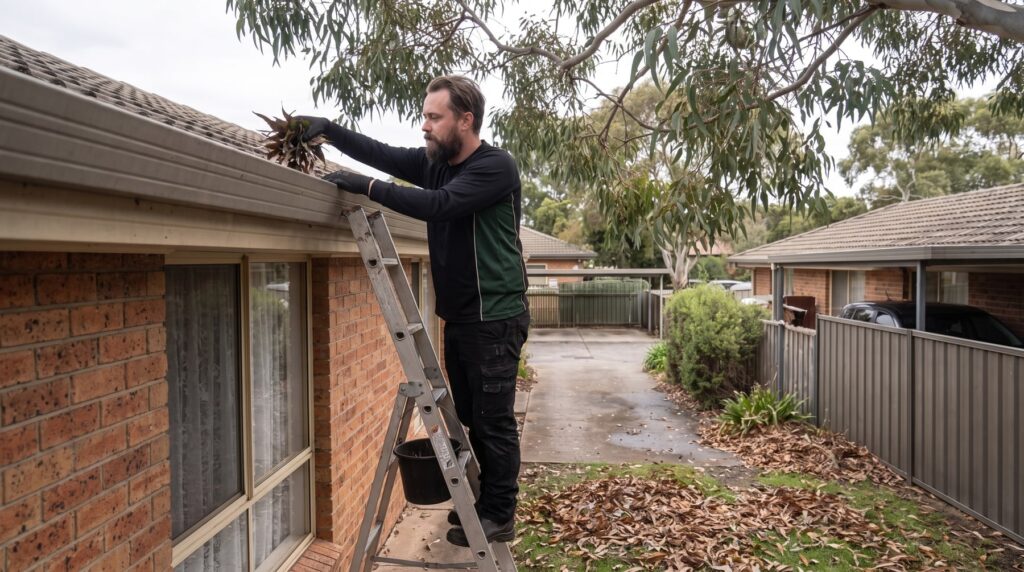
Most Adelaide strata complexes need their gutters cleaned once a year, in late autumn, after the deciduous drop has finished. Complexes sitting under established gums, and any property in the Adelaide Hills, need two cleans a year: one before winter to stop water damage, and one before the fire danger season to reduce ember risk.
That is the short answer. The longer one is that autumn is the single most under-budgeted season on most strata portfolios in Adelaide, and blocked gutters are where that shows up first.
Why autumn is the make-or-break maintenance window
Two things converge in March, April and May that make this period uniquely important on Adelaide strata sites.
The first is leaf drop. Most established western-suburbs complexes sit under planes, jacarandas, gums or claret ash, all of which drop heavily across an eight-week window. A leaf load that looks manageable in early March is genuinely overwhelming by mid-April.
The second is the first sustained rain of the season. Adelaide is a winter-rainfall city. The bulk of the year’s rain lands between May and September, and it arrives after the gutters have spent eight weeks collecting litter. Gutters in that state do not drain. Water backs up under tiles, runs down behind eaves, and finds whatever weak point exists in the building envelope.
By the time that shows up as an owner’s bedroom ceiling stain, the cost of clearing a gutter has been replaced with the cost of repairing a ceiling.
How often should strata gutters be cleaned in Adelaide?
Frequency is driven by what is growing over the roof, not by the calendar. Use the site, not a rule of thumb.
| Site type | Cleans per year | Timing |
|---|---|---|
| Metro complex, minimal canopy | 1 | Late autumn |
| Metro complex under deciduous canopy | 2 | Mid autumn and late autumn |
| Metro complex under established gums | 2 | Late autumn and late spring |
| Adelaide Hills complex | 2 minimum | Late autumn and before fire danger season |
| Complex with box gutters or internal drainage | 2 | Late autumn and mid winter check |
The general advice you will find online is twice a year, spring and autumn. That is written for a detached house with a small roof area. On a strata site the roof area is larger, the tree canopy is usually older, and the consequence of a blockage is shared by every owner in the plan. It is worth setting the frequency against the actual canopy on the title, and reviewing it after the first year once you know what the site produces.
What a blocked gutter actually costs a body corporate
The failure modes on Adelaide strata buildings are repeatable enough to predict.
Water ingress through eaves and roof joints. This is the headline. Soffit linings stain and bow, then need replacing. Internal ceiling cornices crack. Where there is solar on the roof, water finds the cable-entry penetrations.
Concentrated overflow at downpipe heads. A blocked downpipe sends water out at the corner of the building, eroding garden beds and pooling against masonry. Over several wet seasons, this is how rising-damp problems start on otherwise sound walls.
Standing water in car parks and walkways. Surface water that should be heading to a drain ends up sitting in the same low spot for two days, which is how moss takes hold on concrete and how a car park turns into a slip hazard by August.
Insurance excess and maintenance questions. Strata building policies generally respond to water damage, but the excess is a real number the corporation wears on every claim, and insurers can reasonably ask what maintenance was being done. A dated photo record of each clean is the cheapest answer to that question.
Set against that, a scheduled gutter clean is one of the lowest-cost lines on a strata maintenance budget. It is also one of the easiest to defer, which is exactly why it is the one that bites.
The pre-winter checklist
This is the order we work through on every strata site we maintain between March and May. It is also the order we would suggest a committee use to spec their own contractor’s scope of work.
- Full gutter clean and downpipe flush. Every metre of gutter cleared by hand, every downpipe water-tested to confirm flow. Photo evidence at the start, midway and end.
- Roof valley and tile-line check. A visual sweep of all valleys and the bottom row of tiles or sheets for displacement caused by the previous summer’s heat expansion.
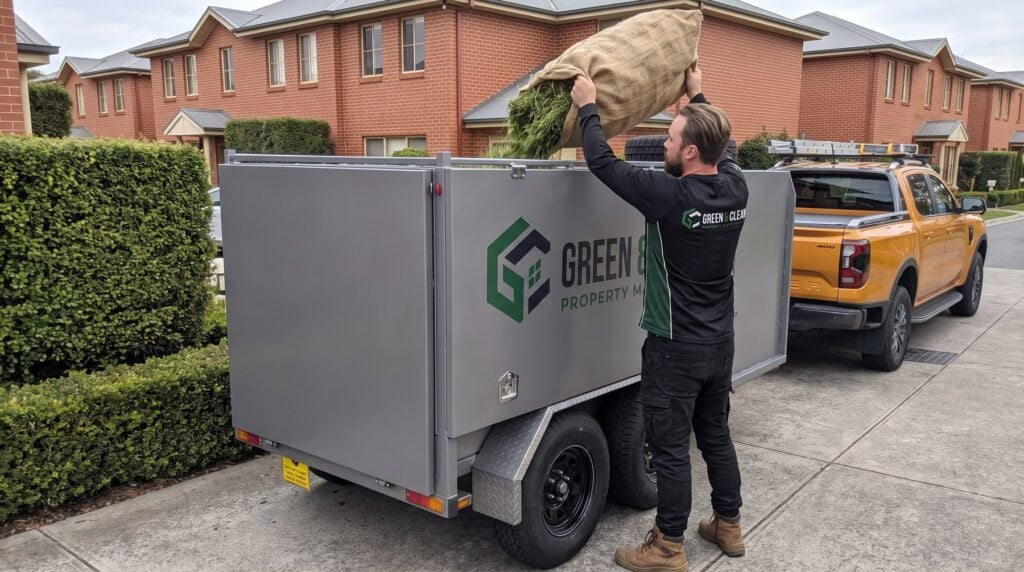
- Common-area leaf and pod removal. Driveways, paths, car parks, garden beds, retaining wall tops. Taken off site, never into the complex’s bins.
- Final mowing cycle and edge tidy. Lawns cut slightly shorter than usual so the next eight weeks of growth do not cover up any debris that has been missed.
- Garden-bed leaf clear plus a fresh mulch top-up. Mulch traps moisture, suppresses weeds through winter, and stops topsoil being washed into car parks during heavy rain.
- Drain grate clear at all stormwater inlets. Including the easy-to-miss inlets at the bases of garden beds and along retaining walls.
- Hard-surface pressure wash where moss has started. A light pressure wash on paths and car park aprons before the moss reaches the point where it becomes a slip hazard.
Adelaide’s leaf drop calendar
The drop calendar in Adelaide is fairly predictable, and it is the reason a single autumn visit rarely does the job.
| Window | What comes down | What it means for the gutters |
|---|---|---|
| Late March to mid April | Planes and claret ash drop their first significant load | The warning that the season is on. Clear hard surfaces, hold the gutter clean. |
| Mid April to early May | Jacarandas drop leaves and small twigs. Eucalypts continue at a heavier rate. | Gutter mouths and valleys start filling. Good window for a first pass on heavy sites. |
| Mid to late May | The last of the deciduous canopy, often in a single windy week | The clean that matters. This is the one that has to be done before the June rain. |
Most western-suburbs strata sites need two visits across the autumn window, sometimes three for sites with heavy plane canopy. The cost difference between one visit and two is marginal against a single water damage claim.
Adelaide Hills complexes: the gutter clean is bushfire prep
For strata properties in Mount Barker, Stirling, Hahndorf, Aldgate, Bridgewater, Nairne, Woodside and Crafers, autumn gutter cleaning is not only water-damage prevention. It is bushfire preparedness.
Leaf litter in gutters is one of the most reliable ignition pathways for ember attack. The SA Country Fire Service specifically calls out clearing gutters of leaves and debris as part of preparing a property ahead of the fire danger season. For a body corporate in the Hills, the autumn clean is the practical work that sits underneath that.
The scheduling difference matters. A Hills complex cleaned in late May is protected for winter but carries a full spring’s worth of litter into December. Hills sites need the second clean, and it needs to land before the fire danger season starts, not after.
Who is responsible for the gutters?
Gutters fixed to the building are almost always common property. In South Australia that puts them with the strata corporation under the Strata Titles Act 1988, or the community corporation under the Community Titles Act 1996, depending on how the plan is titled. The corporation engages the contractor and funds the work from the administrative fund.
The practical consequence is that no individual owner is going to organise it, and no individual owner is going to notice the problem until it is inside their unit. Gutters are only ever cleaned because somebody scheduled it.
What to put in the scope of works
If the committee is writing its own scope or comparing quotes, these are the lines that separate a real gutter clean from a quick blow-through. Ask for them in writing.
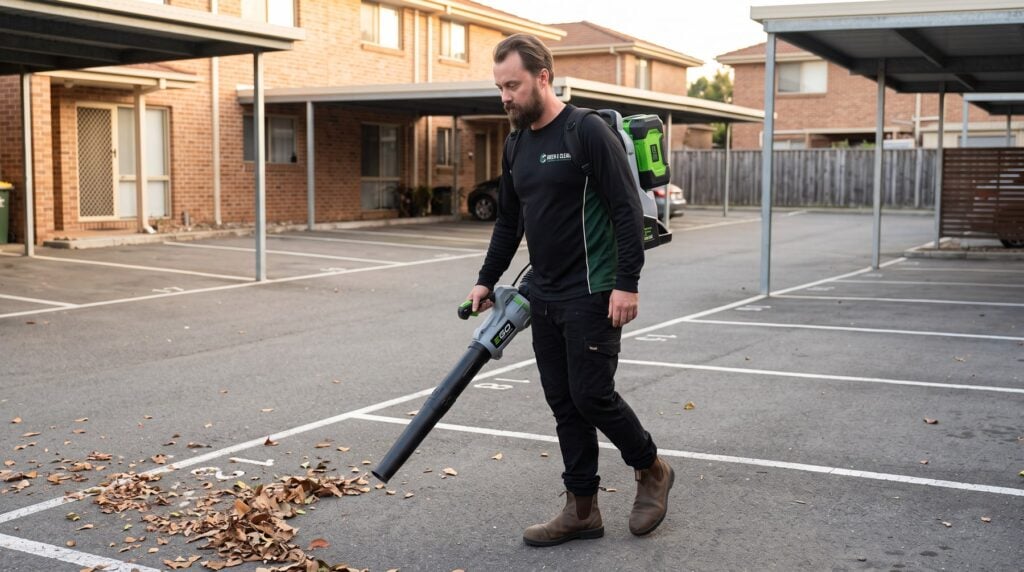
- Hand clearing, not blowing only. A blower moves litter along the gutter. It needs to come out and leave the site.
- Downpipes water-tested, not just visually checked. A downpipe can look clear from the gutter and be blocked at the shoe.
- Valleys and box gutters included where they can be reached safely, and explicitly excluded in writing where they cannot.
- All debris removed from site. Not bagged and left, and not put in the complex’s bins.
- Before and after photos filed against the date. This is the committee’s record and the corporation’s maintenance evidence.
- A written condition note. Rust, sagging, poor fall, loose brackets and failed flashing, reported whether or not the contractor is quoting to fix it.
- A stated height limit. Whatever is reachable safely from ladders, with anything above it flagged for a height-access contractor rather than improvised.
That last one is worth insisting on. A contractor who will tell you what they cannot safely reach is more useful than one who says yes to everything and then works around it on the day.
When to schedule
For a metropolitan Adelaide site:
- First visit: late March to mid April. Catches the first drop and resets the site.
- Second visit: late May. Catches the final drop and confirms the gutters are clear ahead of the June rain.
For Hills sites, bring the second visit forward and add a pre-summer clean so the property is ember-ready before the fire danger season.
If your portfolio is heading into autumn without a scheduled scope for any of this, get in touch. We quote strata gutter cleaning per site or as part of a year-round maintenance program, across metropolitan Adelaide and the Adelaide Hills, and we put the photo-report standard in writing so the committee always knows what was done.
Frequently asked questions
How often should strata gutters be cleaned in Adelaide?
+
Once a year suits most metropolitan Adelaide complexes, cleaned in late autumn once the deciduous drop has finished. Complexes under established gums, or anywhere in the Adelaide Hills, generally need two cleans a year: one before winter for water damage prevention, and one before the fire danger season for ember protection.
Who is responsible for gutter cleaning in a strata complex in South Australia?
+
Gutters attached to the building are almost always common property, which makes them the strata or community corporation’s responsibility rather than an individual owner’s. The corporation funds the work through the administrative fund and engages the contractor. Individual owners are usually only responsible for gutters on structures within their own lot, such as a private carport or shed.
How much does gutter cleaning cost for a strata property in Adelaide?
+
Strata gutter cleaning is priced against the metres of gutter, the roof height and access, and how much litter the site carries, so it is quoted after a site walk rather than off a per-metre rate card. Most bodies corporate get better value bundling it into a recurring maintenance program, because the visit is scheduled into an existing run rather than priced as a standalone call-out.
When is the best time to clean gutters in Adelaide?
+
Late autumn, roughly late April to late May, once deciduous trees have finished dropping. A clean done in early March is usually half a job, because the heaviest drop is still to come. Adelaide Hills sites should add a second clean in spring or early summer, ahead of the fire danger season.
Can blocked gutters cause an insurance claim on a strata building?
+
Yes. Water backing up out of blocked gutters is a common cause of ceiling and eaves damage claims on strata buildings. Insurers can also query whether reasonable maintenance was carried out, which is one reason a dated photo record of each gutter clean is worth keeping with the corporation’s records.
Do you provide photos of the gutters before and after cleaning?
+
Yes. Every gutter clean is photographed before and after, and anything we notice from the roofline such as rust, sagging, poor fall or failed flashing is written up and sent through with the report, whether or not it is work we would be doing.