Why Adelaide Strata Complexes Need a Year-Round Maintenance Program
Reactive maintenance is the costliest habit a strata portfolio can have. What a year-round Adelaide maintenance program covers, season by season.
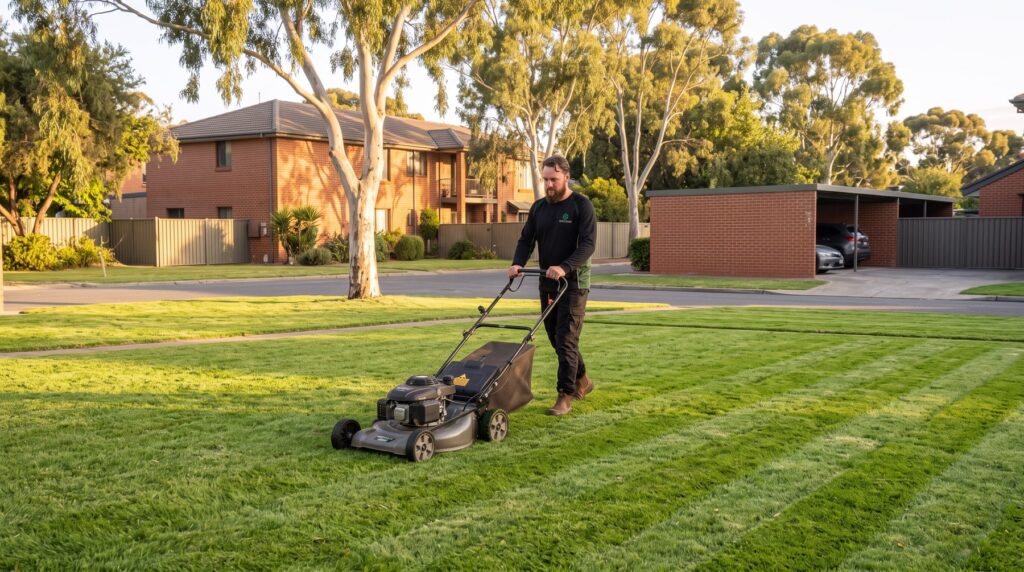
A strata maintenance program is a recurring contract that bundles mowing, gardens, hedges, gutters, pressure washing and waste removal into one fixed monthly fee per site, on a set schedule, with one invoice across the portfolio. It replaces reactive maintenance, and on most Adelaide portfolios it costs less over a financial year.
There is a particular type of phone call every strata manager in Adelaide knows. An owner has noticed the lawn at one of the Findon complexes is knee-high. Or the gutters at the Henley Beach site are visibly stuffed with leaves. Or the car park at Salisbury is so slick with moss that someone slipped on the weekend.
By the time those calls come in, the work is already overdue, the price has already gone up, and the committee is already irritated. That is what reactive maintenance looks like in practice, and on a portfolio of any size it is the most expensive habit a strata manager can fall into.
What reactive maintenance actually costs
Reactive maintenance has three hidden costs that committees rarely add up until they are sitting through an AGM with frustrated owners.
The first is the call-out premium. One-off jobs cost more per hour than scheduled work. The contractor is fitting them around an existing run, so the rate goes up and the truck arrives when it can rather than when you want it.
The second is escalation. A lawn mown fortnightly takes fifteen minutes. The same lawn left for six weeks takes an hour, needs the catcher emptied repeatedly, and stresses the turf in summer to the point of patch repair. Hedges left for two seasons need cutting back hard rather than trimming, and they look bare until spring growth fills them in.
The third is owner complaints, which never appear on an invoice but show up as strata manager hours spent on emails. Every one of those is time not spent on something the committee actually values.
What a year-round program covers in Adelaide
The content of a program shifts through the seasons. A good one looks roughly like this.
| Season | Mowing frequency | Focus work |
|---|---|---|
| Spring (Sep to Nov) | Fortnightly | Weed and mulch beds, hedge shaping, irrigation check and reset |
| Summer (Dec to Feb) | Weekly to fortnightly | Higher cut height for drought stress, blower-vac sweeping, edge and hedge tipping |
| Autumn (Mar to May) | Fortnightly | Leaf clearing, gutter cleaning before winter rain, formative tree pruning |
| Winter (Jun to Aug) | Monthly or less | Heavier tree pruning, pressure washing, retaining wall and drainage checks |
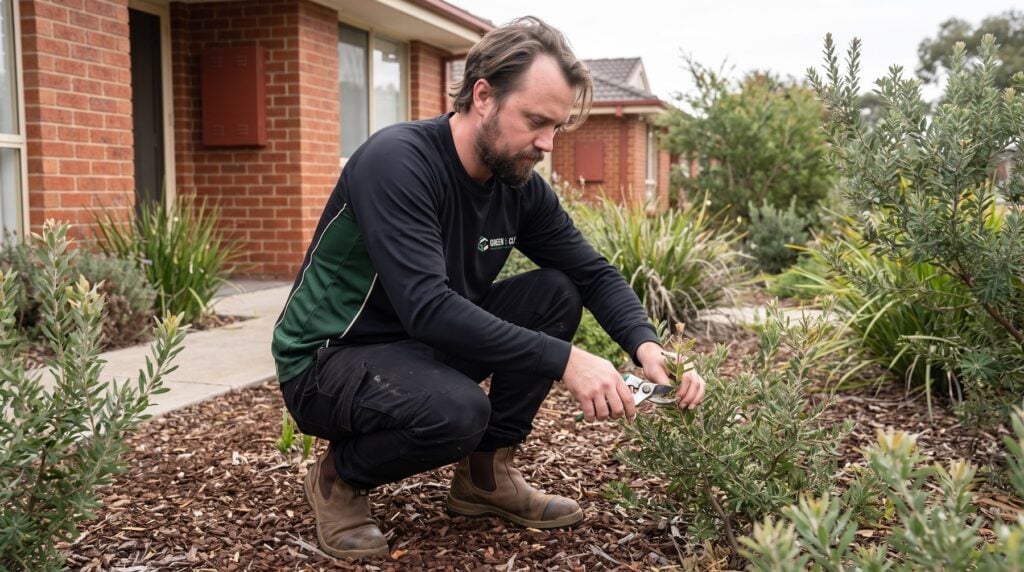
Spring is when growth ramps up and the site gets its visible reset. Beds are weeded and re-mulched, hedges are cut back to shape, and common-area irrigation is checked and set for the warmer months. This is the work that drives committee satisfaction for the rest of the year.
Summer is the high-frequency period for lawns, with cuts kept slightly higher to protect turf from drought stress. Edge work and hedge tipping keep the complex sharp through the period when visitors and prospective buyers are most likely to be on site.
Autumn is the make-or-break window. Leaves come down and gutters need clearing before the winter rain arrives. It is covered in detail in the pre-winter gutter cleaning checklist, because it is the most under-budgeted season on most strata portfolios.
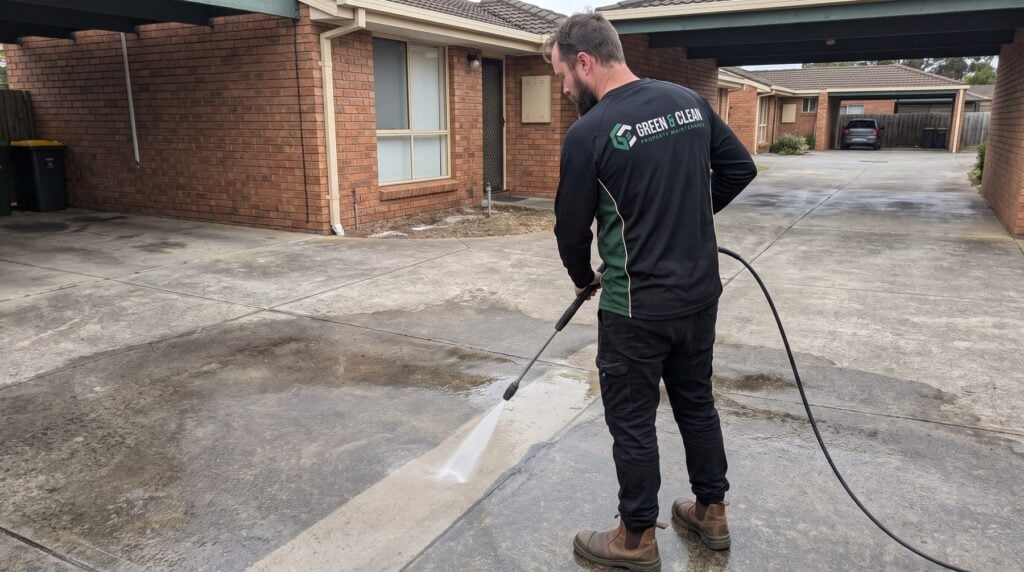
Winter is the quiet season for growth and the right time for structural work: heavier tree pruning, pressure washing of car parks and paths, retaining wall checks and drainage clears.
Why Adelaide’s western suburbs need this specifically
A few things make the western and north western suburbs a particularly poor place to run a strata portfolio reactively.
Mature tree canopy. Findon, Woodville, Seaton and Henley Beach have older complexes built among established gums, planes and jacarandas. Leaf and pod drop is genuinely heavy. A complex that looks tidy in early March can be unrecognisable by late April.
Coastal wind exposure. The prevailing summer southerly drives leaf litter into corners, against fences and through gutter mouths. Cleanup frequency on sites west of Port Road is meaningfully higher than for an equivalent property in the inner east.
Mixed building age. Older masonry holds moisture longer, so pressure-washing intervals are tighter to keep mould and moss down. Newer Colorbond cladding does not need the same attention. The schedule has to reflect the site rather than a template.
Reticulation of every vintage. From hand-watered beds to controller-driven drip lines, irrigation needs season-by-season checking. A scheduled program catches a leaking dripper in November instead of discovering it as a brown patch in February.
Route density. This one is in the corporation’s favour. A large share of Adelaide’s strata and unit stock sits in the western corridor, which means complexes can be scheduled back to back on a single run. That density is exactly what makes recurring maintenance affordable, and it is why multi-site portfolios price better than isolated one-off jobs.
The committee budget conversation
The most useful thing about a program, from a committee’s point of view, is that it turns a spiky cost into a flat one. Instead of a cluster of unexpected autumn invoices for leaf and gutter work nobody budgeted, the committee approves one monthly figure covering the year’s scope. That number does not move with the seasons even though the workload behind it does.
That predictability is the whole reason committees prefer programs to ad-hoc engagements. It also means the maintenance line in the next AGM forecast is genuinely accurate, which is something committees notice.
The second thing it produces is a record. Every attendance photographed and filed against the site and the date gives the manager a one-minute answer when a resident claims the gardens have not been touched in six weeks, and it gives the corporation a documented maintenance history at handover or sale.
How to switch from reactive to scheduled
If a portfolio is currently running on reactive or quarterly maintenance and the committee is open to a program, the move takes three steps.
- Audit the current spend. Pull the last twelve months of maintenance invoices and total them, including the one-off call-outs that were approved separately. This is the real reactive cost, and it is almost always higher than committees expect, because it arrives in small pieces.
- Get a scheduled quote for the same scope. A program for the same work usually quotes lower per site, because the contractor is no longer pricing a call-out premium into every visit.
- Set the cycle and the reporting standard. Visit frequency by season, the seasonal scope, photo reporting after each visit, and how invoices are structured across the portfolio. Lock those in writing for the year.
Step one does most of the work. Committees rarely have the reactive number in front of them, because it never appears as a single line.
What to check before you sign
A program is only as good as the scope behind it. Before signing, confirm the contractor has commercial equipment matched to the site, a legal green-waste destination, public liability cover with a certificate available on request, and a clean exit rather than a long lock-in. The contractor selection questions are worth working through while you are still comparing quotes.
We run this audit free for strata managers and committees across metropolitan Adelaide and the Hills. There is no obligation to change contractors at the end of it.
If you manage strata sites across Adelaide’s western and north western suburbs, or anywhere else in the metro area, get in touch. We will walk the portfolio and put a number on what a scheduled maintenance program would actually cost.
Frequently asked questions
What is a strata maintenance program?
+
A strata maintenance program is a recurring contract that bundles mowing, garden care, hedges, gutters, pressure washing and green-waste removal into a single fixed monthly fee per site, on a set schedule. It replaces the cycle of one-off quotes, chased approvals and unpredictable invoices with one agreed annual figure and one consolidated invoice across the portfolio.
Is a year-round maintenance program cheaper than reactive maintenance?
+
For most Adelaide strata portfolios, yes. Reactive work carries a call-out premium, and overgrown sites take substantially longer to bring back than they take to keep. The saving comes from removing both, plus the strata manager hours currently spent fielding owner complaints and chasing quote approvals.
What does a strata maintenance program include in Adelaide?
+
A typical program includes scheduled lawn mowing and edging, garden bed weeding and pruning, hedge trimming, leaf and green-waste removal off site, periodic pressure washing of car parks and paths, gutter cleaning ahead of winter, and photo reporting after every visit. Tree work above three metres, specialised removals and major one-off pressure washing jobs are usually quoted separately.
How often should a strata complex be maintained in Adelaide?
+
Frequency follows growth rather than the calendar. Most Adelaide sites run weekly to fortnightly mowing through summer, fortnightly through spring and autumn, and monthly or less through winter, with seasonal works such as gutters and pressure washing scheduled into the quieter months.
Are strata maintenance programs a long lock-in contract?
+
They do not need to be. A well-structured program runs on a rolling basis with a clear exit and a written scope, so the corporation stays because the service holds up rather than because the paperwork traps them. A long lock-in term is worth questioning at the quoting stage.
How do we move a strata portfolio from reactive to scheduled maintenance?
+
Total the last twelve months of maintenance invoices to establish the real reactive spend, get a scheduled quote for the same scope, then set the visit frequency, seasonal scope, reporting standard and invoicing structure in writing for the year. The audit step usually surprises committees, because reactive spend is spread across many small invoices.